Fred Phelps was just on the news doing his thing about the Victoria Bushfires. He accuses Australia of being a 'fag nation' and says that the people killed and affected by the fires deserve it because of the evils perpetuated by the nation.
A Kazakhstan court has bannedScientology as an abuse to the rights of freedom of religion. More developed countries should be ashamed that thay have note done the same.
Wow, I'm not sure what to say about this... It kind of encompasses a number of ideas that we have been discussing lately. Meat production, intensive farming, artificial selection and advancement in science. The result is... well, just see for yourself!
All too often we hear that a belief in science requires the same amount of faith as a belief in god. This is just plain wrong. Science uses empirical evidence based on observation and measurement. It does not require you to take anything on faith. If you are still struggling to grasp this concept, check out this video.
This is a great little video that is a basic introduction to the theory of evolution, and addresses many of the misconceptions that we continually hear time and time again.
Wow, this is such a great video. President Obama talks about the vast scope of science, putting in perspective how important the scientific process is in every aspect of our world. This ranges from preserving the environment for future generations, advances in life saving medical procedures, to monitoring the economy, and technology improvements for security.
This is very encouraging, as it has been a very long time since America has had a President that has got it right like this one.
"It's time we once again put science at the top of our agenda" - President Obama.
When the original screening was cancelled Lord Ahmed told the Pakistani press it was "a victory for the Muslim community". http://www.app.com.pk/en_/index.php?o...
I like how one of the rebuttals was "The fool says in his heart there is no god", apparently unaware of Matthew 5:22 "whosoever shall say, Thou fool, shall be in danger of hell fire".
He has finally got around to uploading my favourite series "Growing up in the Universe". It is a collection of videos that explore basic important concepts in science, and it was from this lecture series that "Climbing Mount Improbable" was written.
If you haven't seen it already, it is definitely worth checking out.
There are 5 one hour videos, so clear your schedule and enjoy!
If you prefer to, you can buy the DVDs (as we did) and enjoy it over and over again.
We've just broken the 10 000 hits barrier for this blog!
Woo hoo!
Thanks to everyone that has been supporting us over the last six months or so. You keep us motivated to keep it up!
And to those with whom we have differing opinions (and occasionally heated arguments), thank you for your keeping the discussion alive! It wouldn't be the same without you!
Now, as a token of our appreciation, and reverence in the holiday trinity (Darwin day, Friday the 13th and Valentines day) that is upon us, please enjoy these videos.
This is a wonderful song from a few year back by one of my favourite musicians of all time, Lou Barlow from Sebadoh. The first time we heard this song was when he performed it live at The Basement here in Sydney, and the crowd broke into giggles! Here is the video, and the lyrics are below:
Immaculate conception, yeah right Crazy Mary it's good that you lied A test tube baby, seed of the lord Breaking the law with the man next door
Blame it on an angel, they'll believe Joseph will wonder but you know he won't leave They all love you like I still do Magin in the air, swirling around you
Mary, Mary under veil of stars You changed the world, you broke my heart Thank you Mary, you saved me too They'd stone us both if they ever knew
Sold out the manger, well alright The mystery baby got a supernova spotlight They say that he's the One Brother Joseph got a king for a stepson
(Chorus)
Mary kissed me and we lost control The oldest story never told Crazy Mary you're forever divine They'll never know the baby's mine
Today we celebrate Darwin Day, the 200th anniversary of the birth of Charles Darwin. 2009 is also the 150th anniversary of the publication of 'On the Origin of Species', but that was published on the 24th of November (A very special day indeed!), so we'll have to wait till then for that one.
Charles Darwin was a British naturalist who developed the concept of natural selection. Basically, if you look at the way that farming works, taking the best examples of a current crop to grow an improved future crop (or heard, etc), that is artificial selection. The overall quality of the crop over time improves because the better samples are selected for by the farmer. The poor quality crops are not used to seed the new crops and therefore don't contribute to the ongoing quality of the overall yield.
Natural selection looks at artificial selection and says that what the farmer is doing in selecting for the better samples, which improves the quality of the overall crop, also happens in nature. This comes from a combination of many pressures, most notably resources and reproduction. The more able an organism is to compete for resources and the ability to reproduce, the more offspring it will have, the more it's characteristics will be passed on to subsequent generations. This also works in reverse for the unfit organisms. If they can't acquire resources or reproduce, they will die and not pass on their genetic material. The combination of these processes leads to a slow, gradual shift in populations towards more fit examples of the organism. The natural pressures have therefore selected the better examples, which have enjoyed more chances to reproduce, which increases the percentage of the population in which the successful genes are displayed.
The beauty of the theory is the incredible simplicity of it. It accounts so well for the variety of life on the planet and has been shown time and time again to be the best explanation we have.
There is a bit of an argument between some (definitely not all) religious people and the scientific consensus over the truth of the theory, but there has never been presented any evidence able to significantly dis-rail the theory and it seems that, for the most part. Those arguing against evolution are basically doing it because of the repercussions that it has for the ideas that man was created as separate from the animals, that all life was spontaneously created and that the earth is too young to allow the times needed for evolution to occur.
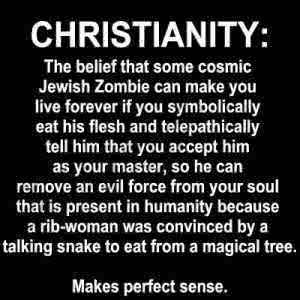
These are all unsubstantiated rubbish being spouted by foolish people clinging onto the memoirs of a zombie jew-king by their fingernails, wishing that they could support their beliefs. It's the theological equivalent of sticking your fingers in your ears and going "lalalalalalalalalalalala I can't hear you!!!!"
This pretty much sums up my conversations with the vast majority of christians. After all the discussions and trying to defend their position logically, it all comes down to a series of leaps of faith.
As Darwin day gets closer, who better to explain the importance of Darwin than Richard Dawkins
Richard Dawkins Exclusive Interview: Professor Richard Dawkins explains the importance of Charles Darwin, what evolution means and why the National Geographic Channel should celebrate the bi-centenary of his birth. Watch the exclusive interview with Richard Dawkins now.
We arrived about 45 minutes early, which gave us a chance to check out the books that were on sale before the stand was swarmed by other attendees. I bought a copy of ‘Animal Liberation’.
Everyone from our group (about 10 people, I think. Maybe a few more) arrived and we went and got some pretty good seats up near the front. Margaret, whose birthday it was (happy birthday, Margaret!) was sitting next to one of the cameramen, who got into a discussion about the origins of the Flying Spaghetti Monster, and explained that the talk was being taped for ‘ABC 2 Forum’, so keep an eye out for it (I’ll post it on the blog if I find it).
Singer started by explaining that this book has been 30 years in the making, as it pulls together a variety of ideas that have been discussed in part in the article ‘Famine, Affluence and Morality’, and in bits and pieces across many of his other books, but it was a topic that, to comprehensively cover it, would require a full book of it’s own.
Over the time that has passed since his article on Famine, Affluence and Morality, Singer noted that the percentage of people in the world living in ‘Extreme Poverty’ (under $1US a day) has dropped from approximately 40% to around 25%. This is an encouraging statistic, no matter how you look at it!
Singer then explained the pond dilemma. If you see a child drowning in a shallow pond, almost all people would jump in and save them. Now imagine that you are wearing a brand new pair of nice business shoes, worth a couple of hundred dollars. Now would you save the child, at the cost of ruining your shoes? Again the answer is an almost unanimous YES!
This is the basic moral argument of the book. It is, in most cases, worth paying a small personal cost for a large social gain.
There are, Singer explained, 27000 children under 5 dying every day. Would it not be worth a little of your money, which you probably would have spent on something you didn’t need, to make a difference in that statistic?
Singer explained that there is a strange attitude towards focused tragedy, such as the September 11 attack, when more children are dying each day than the number of people killed in that single act. By supplying the funding to provide mosquito nets, immunisation and health care clinics, we (those of us lucky enough to live comfortably in the first world) have the ability to actually save lives!
Singer made a point that you have to be sceptical bout the statistics given to you. For example, for the cost of a single mosquito net, you will not be saving a child’s life. Not all children with out nets die, not all children with nets are fully protected. Instead of the, as advertised, ‘$10 to save a life’, the cost per life saved is actually in the hundreds of dollars, once you crunch the numbers, which brings you back to the pond analogy and saving a life for the price of a pair of shoes.
Where the real world poverty problem diverts from the pond analogy is that there is only one child to be saved in a pond, whereas there are millions of children to be saved from poverty, so how much can you be expected to give away without causing your own economic problems?
The practicality of giving away all but the absolute necessities doesn’t work. There are a few people (1 in a million or more) who live this kind of existence and give everything that they don’t immediately require, but you are never going to expect the wider population to share this ethic. It’s unrealistic. Singer’s solution is that by gradually raising communities’ standards, so that many people are giving a small amount each, we will actually be making a bigger difference than a small number of people giving everything.
Singer then described the different minimum standard donations that he prescribes for different income brackets.
For those earning up to
$100k, a 5% donation will suffice (up to $5k a year donated)
$100k- $1M- a 10-15% donation should be possible
$1M plus, a 30% donation should be made.
I’m sure this is the part that most people are going to have difficulty with. I’m thinking, at this stage, that for me to give up a few thousand dollars per year to charity is an unrealistic ask! (however, after thinking about it, I have decided that I will try to give a respectable amount to charities that I can be sure are spending the money wisely, and not using it to further any peripheral goals)
And so ended Singer’s talk. You can find out more about what you can do to help minimise poverty by getting a copy of Singer’s book.
There followed a QnA session.
Eran, a regular at the atheist meetings, and a member of the Australian Skeptics, asked about the mismanagement of funds and the problems inherent in giving money to a corrupt regime.
Singer’s response was that there are many charities that are fairly reliable and trustworthy in disseminating donated funds to where it will make the most difference, such as Oxfam, Unicef and the Gates foundation. He admits that the occasional scandal does happen, but that does not mean that withholding donations totally is the correct response. Also, it is advisable to donate to charities that give money to NGOs, who generally distribute the funds more appropriately than a ‘regime’ might.
Then, a man asked about the ‘superogatory ethico-moral duties privileged nations to provide not only funds, but sustainable means of selfperpetuatalising pericombobulations. (I think it was an arts major)
Singer then explained that sustainability must be considered whenever developing and providing resources to the third world. How he understood the question, I’ll never know!
Someone got up and proposed that a more fitting conclusion to the pond analogy would be that after saving the child, the protagonist then goes about his job as a shallow pond digger! Singer seemed to like this analogy and suggested that there would be a more in-depth explanation of such issues in his book.
Perhaps the most interesting question (to the nature of this blog and the Sydney Atheists in general) was “Do you believe in a god and if so, do you believe that you should have been consulted in the creation?” To which Singer’s response was “I think that the second part of the question answers the first. If there was a god, then we wouldn’t be in the situation we are now.” “All life can be best explained through the process of evolution [sic]”
After the talk, we had a chance to meet him (as did everyone else in attendance, if you waited in line long enough!), he signed our books and we spoke to him about the influence that his book “The Ethics of what we eat” has had on our recent decision to become vegan. He was really accommodating and despite there being a huge crowd waiting to get their books signed, was happy to have a discussion with us. We were very happy and, by all accounts had a wonderful night!
If you’re interested in Peter Singer and are in the Sydney area, Nathan and myself will be giving a talk about Peter Singer’s career and most influential ideas (ethics and consumption) at this weekend’s Sydney Atheists meetup. It’s bound to be a good night and we hope that people will all be a little challenged by the content.
BONUS VIDEO!
Peter Singer debating Dinesh D’Souza
Also, Phillip Adams interviewed Singer on the day of this talk. Listen to it here.
Over the massive front doors of a church, these words were inscribed, "The Gate of Heaven." Below that was a small cardboard sign which read, "Please use other entrance."
An atheist buys an ancient lamp at an auction, takes it home, and begins to polish it. Suddenly, a genie appears, and says, “I’ll grant you three wishes, Master.” The atheist says, “I wish I could believe in you.” The genie snaps his fingers, and suddenly the atheist believes in him. The atheist says, “Wow. I wish all atheists would believe this.” The genie snaps his fingers again, and suddenly atheists all over the world begin to believe in genies. “What about your third wish?” asks the genie. “Well,” says the atheist, “I wish for a billion dollars.” The genie snaps his fingers for a third time, but nothing happens. “What’s wrong?” asks the atheist. The genie shrugs and says, “Just because you believe in me, doesn’t necessarily mean that I really exist.”
A Christian, a Jew, and an atheist are standing in line to be executed during the French Revolution.
The christian is first, and he lays down on the guillotine. Before the executioner pulls the lever he shouts, "My god will save me!". The lever is pulled, and the blade swooshes down, stopping just short of his neck. The executioner, believing a miracle of god has occurred, figures he can't kill this man, as so sets him free.
The Jew lays down on the guillotine. Like the christian, he shouts, "My god will save me!". The lever is pulled, the blade falls, and once again it stops just short of his neck. The executioner, again, believes god is on this man's side, and lets him go.
Finally, the atheist lays down on the guillotine. He examines the guillotine, finds a rock in the gears, and says to the executioner, "Well here's your problem..."
The moral? There's a time and a place for skepticism.
This time last week, I was getting ready to go to church. Yes, an atheist, getting ready to attend church. I attended with four other members of the Sydney Atheists. We attended a presentation at Toongabbie Anglican church, a talk entitled "Does God Exist".
Upon arrival, we affixed our compulsory name tags, and were greeted by many friendly, smiling Christians, many of whom were complaining about the intense heat. Thank god for the air conditioning in the church!
The evening opened with a few prayers and some jesus themed music from the band. Donny Kwan then began his topical talk. He opened with a brief outline of the four main arguments: cosmological, ontological, teleological and the moral argument. One of my favourite annecdoetes was a discussion between an "atheist" and a Christian. It went something like this:
Christian: So Mr Atheist, can you see god? Atheist: No... Christian: Can you smell god? Atheist: No... Christian: Can you see your own brain? Atheist: No... Christian: Can you smell your own brain? Atheist: No... Christian: Aha! But you know you have a brain! This is the same way we know god exists.
Seriously. I really did have to bite down hard on my tongue to stop the laughter. Afterwards, we asked Donny if he had ever heard of an MRI scan? This allows us to see our own brains! Hooray for medical science! As hard as we have been trying though, none of us have yet had a whiff of our own brains...
Other examples he used to argue for the existence of a god were "clues in creation". "The skies proclaim the work of his hands," he said. No, the sky is a completely natural phenomenon and is the atmosphere around the earth. The existence of the sky is in no way any evidence for the existence of god.
Donny likened "clues in creation" to a game of Cluedo, where by investigating all the clues of the crime you can come to a conclusion about whodunnit. This metaphor it similar to the watchmaker argument, likening the fact that a murder case has a murderer, the universe has a designer. This is one of the worst argements for the existence of a god, and is often used by the credulous Ray Comfort. It is a faulty analogy, debunked so well by Richard Dawkins in "The Blind Watchmaker". As an aside, Donny quirked (in regard to the game Cluedo) "I've never understood how you could kill someone with a candlestick!". You beat them Donny. A candlestick made of metal will do a lot of damage if you constantly beat someone over the head with it.
The rest of the talk was filled with arguments from the bible, such as "god speaks to us through the bible, so therefore he exists...". I was really hoping for some interesting arguments, but when all you talk about is "evidence" from the bible, it is completely unstimulating and boring.
The bass player from the band then got up at the end to say a prayer that he had written. He started by expressing his absolute sadness and dismay that in these modern times we would need to even be asking a question such as "does god exist". He then went on about how atheists are spreading hateful messages, and that we need to pray that Richard Dawkins stop spreading his disgusting messages. At this point I got the giggles and really had to exercise some self control. The hilarity factor was going off the scale.
Before the talk we were given a pamphlet encouraging us to take notes throughout the talk, on which the pamphlet says "take notes to raise a question for future discussion." However there was no Q & A at the end. We had many, many questions and points we wanted to clarify, which would have been useful for the congregation to hear, but no one was asked if they had a question. At the end of the pamphlet is a box that says "Do you believe in this God who exists?". I find this question rather odd in the way it is worded. It assumes that the god is a who and that it exists. If you answer no, then they would argue that you are denying god, because he does exist, rather than asking the question "do you believe in a god?".
We then had some very interesting discussions with Donny, and a few others who were interested in what we had to say. It was very friendly and I was pleased that they welcomed us and these discussions. We discussed topics such as contradictions in the bible, to which we were constantly told "but you have to consider the context!". Yes, in some cases this maybe so, but I suspect that most of their points of reference consist of christian apologetics. I was recommended to watch Tim Keller's Authors at Google talk, as he is "one of the best apologetics and difficult to refute". I watched it, and it was pretty bad. In fact, it was truly awful. (I will blog about that talk another time). Honestly, if that is the best they've seen, then they have some serious researching to do.
We do thank Toongabbie Anglican church for welcoming and being so friendly to us, and we had some great conversations, which were stimulating and interesting. We would love to have any of them come to our meetups, or even give a talk. Details can be found at www.sydneyatheists.org.
Christian apologists need to get with the program!
Christian apologetics are basically the strongest arguments that the Christians have to support their claims and beliefs. Apologetics is the branch of theology that attempts to rationalise the various aspects of the faith.
They do this through various means, including reinterpreting the bible (when it says seven days, it actually is referring of millions of years), trying to support the biblical stories with a variety of (mostly weak) evidence (Kirk Cameron, John Dickson, etc), emotional appeals (atheism leads to Nazism) and poorly reasoned/misinformed arguments (bananas, peanut butter and John Lennox). The remainder of their arguments seem to be based on incorrect definitions (atheists believe there is no god), outdated and previously debunked arguments (Pascal's wager123, fine tuning 1 2 3 and irreducible complexity 12 3).
The introduction of the internet has made it so easy to debunk such apologetic arguments (the search words 'debunking apologetics' got 37600 hits in google) that those who make such arguments are up against a wall of criticism, which they may not have encountered in their normal parochial activities, where they are more likely to just yabber on to an already convinced crowd about some poorly structured, loosely based and inadequately researched ideas that just came into their head on a Saturday night. Basically, it seems that there has been little or no internal fact checking and scrutiny for the most part for these religious leaders. Now we have a brilliant new technology that lets a fire hose of ideas burst upon any chink in the system, making any faults in the arguments presented obvious and causing the whole pile of rubbish to come tumbling down.
The main point that I am trying to get at here is that basically, there has been very little in the way of new apologetic arguments developed in recent times. The creationists, nee 'Intelligent Design' crowd have repackaged their ideas in an attempt to convince some of the current generation, but they seem to be unable to resist the backlash of the switched-on online community.
I would like to see some new arguments from Christians.
All I can see at the moment is a blatant attempt to recycle ideas that were debunked by one generation and try to sell them to the next generation. I'm afraid that the christian community is suffering under the transparency afforded by the internet age and can't keep up. Why might this be? I suppose it is because they are fixed in using 'old methods' that have been tried and tested over the years, which are out of touch with the tech savvyyouth of today.
I would like to see someone come up with a new proof of god, a new reason to believe, a new original idea. I really would! It seems that, for the religious skeptic, most of your time is devoted to fending off ideas whose faults were exposed over a hundred years ago12!
Please, If you are a christian reading this, put forward your best arguments.
If there really is a god1234, how would I know this, how would I verify this and what would convince me that it is real?
This in NOT a veiled attempt to try to act like I, or non-believers in general know everything. I GENUINELY would like to hear some new argument. I would like to have to work on a new idea that is proposed, I would like to be CHALLENGED by the arguments of a religious person and have to reassess the way I look at the world.
Please, if you have anything worthwhile, let me know and we'll see if there is anything worth discussing.
I have been a lacto ovo vegetarian for almost 3 years, and have recently been considering the ethical arguments for such a position. Alan has almost finished Peter Singer's book "The Ethics of What We Eat", and I am making my way through it. Singer outlines the processes and conditions of factory farmed animals, pointing out that if abboitoirs had glass walls, there would be far more vegetarians. The processes and conditions that sentient animals such as cows, pigs and chickens suffer through is horrific, and at times just the thought made me feel physically ill.
Piglets are taken from their mothers, kept in concrete pens without bedding, fattened too quickly and treated as breeding machines. They are unable to walk, roll or turn around, suffer lameness, heart attacks and insanity. Six pounds of grain are used for every pound of boneless meat produced, putting stress on the environment. This is just the beginning.
Australia has a highly intensive factory farmed chicken industry, with the market dominated by Inghams and Bartter/Steggles. As the chickens near market size, the are unable to move without pushing through other birds, they are unable to stretch their wings at will, or get away from other more dominant and agressive birds, causing great stress. When you walk into a chicken shed, you will experience a burning feeling in your eyes and lungs, which is ammonia from the bird droppings. The birds are bred to produce the maximum amount of meat in the least amount of time, feeding on the least amount of food. This causes their muscles and fat to grow faster than their bones, leading to leg and joint problems, chronic pain and bone disease, paralysis from broken vertbrae, which leads to collapse and the inability to get to their food and water, everntually leading to starvation. This happens to 400 million chickens in Australia, and almost 9 billion in America.
At 6 weeks of age, the birds are caught by factory workers and put into crates, then on a truck to be slaughtered. Birds are grabbed by their legs (to increase efficiency, they are grabbed by one leg so four or five birds can be held in each hand) and flap and writhe about, often suffering dislocated and broken hips, broken wings and internal bleeding. Their feet are locked into metal shackles hanging from a conveyor belt that moves towards the killing room at the slaughter house. Approximately 90 to 120 birds are killed per minute, or 7200 per hour. Extreme cases of torture have been video documented of slaughter house workers who become immune to the nature of their work, which I am not going to write about here because it is too disturbing. For more information, I recommend Peter Singer and Jim Mason's book "The Ethics of What We Eat". There are also a number of websiteswith articles and videos.
Many vegetarians that drink milk and eat dairy products (including me until recently) argue that milk/dairy isn't actually meat, so is acceptable to eat. However, after doing just a small amount of research, I leaned alot about the dairy industry and was forced to confront issues I had never faced before. Dairy cows, like the chickens, are bred and injected with growth hormones to produce as much milk as possible, which causes considerable stress on the cow's body. The cows are atifically inseminated about once a year, as they only produce milk when they have given birth. Calves naturally feed from their mother for about six months, in which time a strong bond is formed. At dairy farms, calves are whisked away from their mother within hours (or less), and the mother's often display distressed behaviour, such as bellowing, roaming and searching behaviours, often at the last place the mother was with her calf. This behaviour has been known to last for up to 6 weeks.
Then another question really started to get me thinking... what happens to the male calves that are born on a dairy farm? If the female calves replace the culled dairy cows, what happens to the males? (Dairy cows are slaughtered between 5 and 7 years of age, even though their natural lifespan is around 20 years. This is because the cows are unable to continually produce the unnaturally high rate of milk demanded by the dairy industry). Well, male calves that survive are usually sent to auction before they have even learned to walk properly. If they are not slaughtered immediately, they are raised as "milk-fed" veal. For this, they spend the next 16 weeks of their lives confined in semi-darkness in a crate not large enough for him to turn around, tied around the neck to further restrict movement. Stressed from being separated from his mother, the calves are fed on a milk replacer, a diet which is deliberately so low in iron that he will develop subclinical anemia. This is desired as it means that the calf's flesh retains the pale pink colour and soft texture, as opposed to the normal healthy red colour of a 16 week old calf. For this reason, calves are denied hay or straw for bedding (because he would eat it, and it contains iron, hence changing the colour of the meat); the same reason for the wooden stalls and neck tethers - no iron fittings as the calf would lick them and get iron, and if he could turn around, he would lick his own urine in an attempt to satisfy his craving for iron.
(Yes I am aware that PETA have done some very stupid and unethical things. However this is why it is so important to do your own research from a variety of sources and come to your own decisions about the choices you make).
Personally, I am convinced by the arguments (those mentioned here are only the beginning) and am giving a vegan diet a go. Initially, it was difficult to give up cheese and especially milk, however I have found a brand of soy milk that is quite nice. We have also found varieties of vegan cheeses and yoghurts that are very tasty. From my experience, people are often uninformed about the variety of alternative choices of ethically sourced food out there. It only takes a bit of consideration and research to improve this.
I am not evangelising and in no way fanatical about veganism or vegetarianism. However the betrayal that we do to ourselves when we choose to be ignorant is denying ourselves the opportunity to make informed decisions about our food choices and ethical decisions. I encourage everyone to do their own research and make decisions that are best for them.
So, you've heard lots of commercial news reports gushing over how amazing it is that a person with dark skin has become president of the USA. Ok... that's a landmark event, but the fact that Obama's skin colour is such an issue shows that we (by we I mean the whole first world) are still guilty of a racist mentality.
Racism is basically treating somebody differently based on the colour of their skin. "It's amazing that we have a black president" IS a racist thing to say. Didn't Dr King dream of a day when the colour of a man's skin should matter no more than the colour of his hair?
It does not matter to me that Obama is black. I am happy that he is in office because that means that a pathetic turd has been given his marching orders.
I'm not even 100% behind Obama. He sill holds some views that I object to and, because of the news focusing mostly on his race, I'm not even well informed about his political stances. But I am happy that Dubya is out. He just seemed to be the most idiotic president that I have ever heard of.
But this leaves me thinking "What is there to be excited about, now that Obama is in?"
For that, I'll pass you over to minds much srarper than mine. So here is what some players in the freethinking community are saying about Obama's inaguration:





 Posts